In Vajrayana Buddhism, the bardo (TI: བར་དོ) state confronts all sentient beings between death and rebirth. It is a liminal space where possible future lives unfold before the mind-stream, although constrained by past good or bad karma. Depending on the actions of the being's past life, and countless lives before that, the new birth takes on a different character. Its new realm of existence, which can range from a repeated human birth, a particularly auspicious rebirth as a deva (or deity) or into a hell-realm, is determined by both reflection and meditative practice in the bardo state and the ripening of past karma.
In the decades after the destruction of the Soviet Union in the 90's, I feel like leftism has been in an analogous state. While popular and ideological struggles continued unabated, there was a widely-felt hit to morale and concrete challenges to organization. Many activists did a good amount of reflection and summation on what worked and what was less fruitful, with some choosing to leave the path of revolution and become revisionists. As the Pink Wave in the Global South and Occupy in the North erupted, along with later developments such as the 2016 Bernie Sanders campaign and the Black Lives Matter movement, leftism began the process of rebirth (what a Tantric practitioner might call a "bardo of becoming").
In my opinion, the emerging rebirth of leftism is neither a total departure from the past nor an isomorphic replication of Cold War organizational ideas, problems, and conflicts. Rather it includes both continuities and changes. Helpful here may be one of the Buddha's most important philosophical contributions on the secular side of things, his doctrine of no-self (anatman). Unlike the proto-Hindu Brahminic milieu he separated from, the Buddha denied the existence of an unchanging, discrete self that transmigrates between lives. Rather, he argued that what we call the "self" is an arbitrary reification of a number of mental and material processes. These processes are linked from moment to moment, but consist of drastically unrecognizable changes; think of the difference between your body as a child and your body as an adult. While the day-to-day difference may be imperceptible, even the material basis of our consciousness is impermanent.
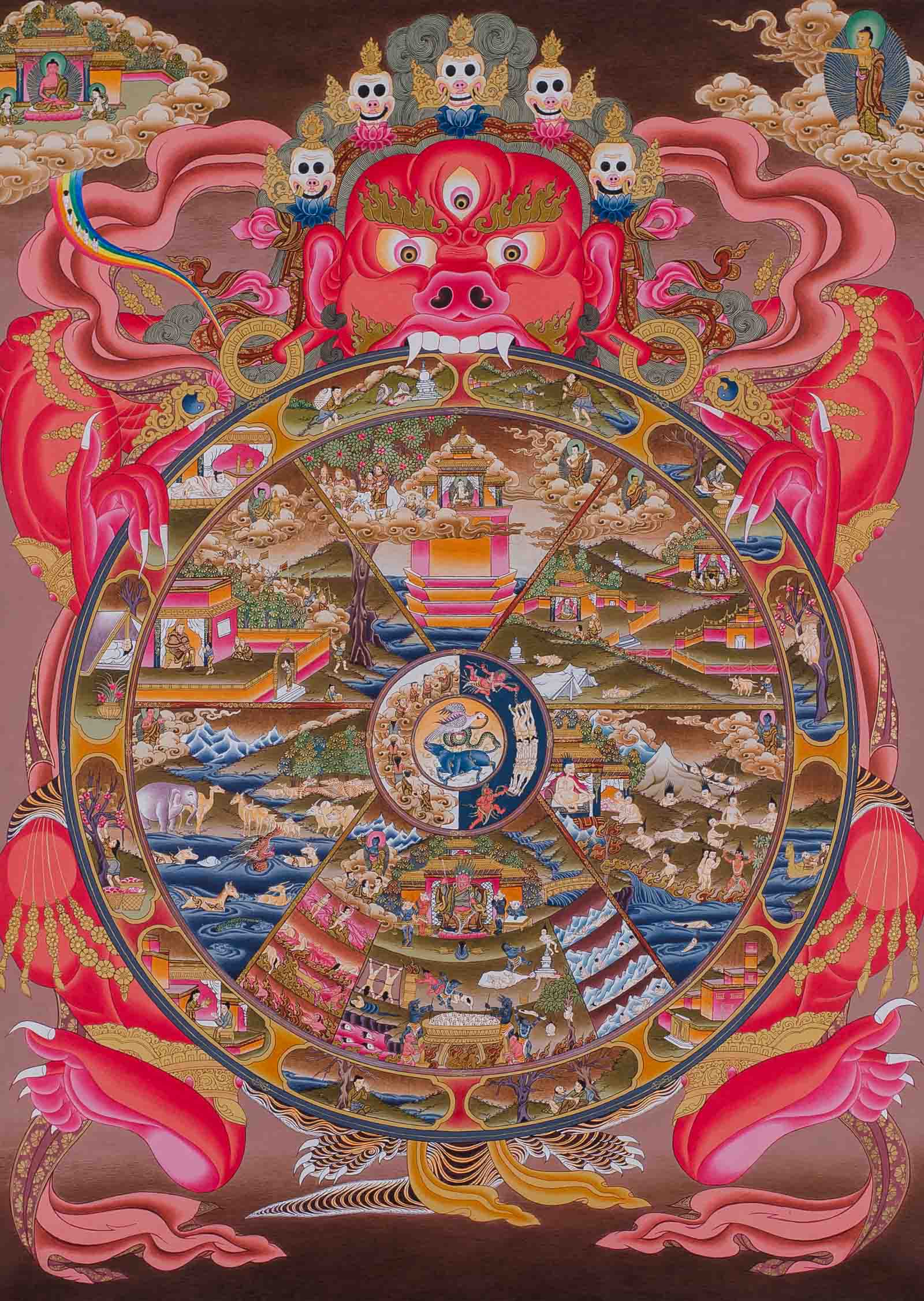
You are here.
Leftism is replete with demonstrations of no-self, as anyone who has organized for a protracted period will know. An advanced person can degenerate through a personal bardo state, transforming into a defector from revolutionary activity, and a reserved, intermediate middling can likewise develop into an advanced fighter. But more interesting is the broader implication that the whole world is lacks such unchanging identities, the doctrine of emptiness (SK: शून्यता; sunyata). Asked if the entire world is empty of self by one disciple, the Buddha replied, "Empty is the world" (Suttanipata 35:85, IV 54). Just as our ego is only a conventional designation of a fluid dialectical process, organizations and movements should not be mentally reified and taken as unchanging constants.
With emptiness in mind, you can really see the births, deaths, bardo, and rebirths in the people's struggles: hitherto dominant community organizations grow detached from their social base and whither away, and marginal organizations toil in obscurity for years before reorienting themselves and becoming key players. Here the Worker's Party of Belgium (PTB/PVDA) always strikes me as such a favorable rebirth, emerging out of a long period of subcultural anonymity to become a major political party and trendsetter for the whole European Left. Key to this reconstitution was the PTB's 2008 party "renewal" conference that rethought their strategy and outreach to the people. Strengths and weaknesses of their line aside, their auspicious rebirth into a major political force was nonetheless conditioned by their past actions (karma): their decades-long experience in trade unions, community organizing, and mutual aid, even when these activities did not lead to growth in the moment, subtended a greater transformation.
While the Buddha's assertion that "empty is the world" has been mistaken as nihilism by some Westerners, it's actually an affirmation of possibility and hope. As the later Buddhist philosopher Nāgārjuna states:
"For whom emptiness is possible,
Everything is possible.
For whom emptiness is not possible,
Nothing is possible."
(Mūlamadhyamakakārikā 24:14)
If we realize the emptiness of all things, we see latent possibilities that we would otherwise overlook with a dogmatic, reified view of the world as unchanging and permanent. As leftism in the United States leaves its bardo of becoming, 20th century organizations and ideologies have taken on new lives according to their ideology, experience, and material basis. As the karma of their past organizational attitudes constantly comes into fruition, the ones who can see emptiness (seeing dialectically in other words) can build on past victories and transform failures into success through the process of criticism/self-criticism. Excluded are those who deny these fundamental truths, who will find themselves reborn into the same situation or a lower realm of existence.


No comments:
Post a Comment